A Security Architecture Document that writes itself.
The document security architects dread writing is the by-product here, not a separate task. As you work the design-stage journey, each chapter assembles live from the real records: scope, threats, controls, exceptions, residual risk and readiness. Doing the work is writing the document.
The design record, assembled not authored.
A Security Architecture Document sets out how a solution is designed to be secure: its scope, its threats and controls, its exceptions and its residual risk. Traditionally it's hand-written after the build, if it exists at all.
In Cybereen it's the opposite. There's no blank template to fill in at the end. Every time you confirm a scope decision, accept a threat, commit a control or record an exemption, the matching chapter of the document assembles itself. Open it at any point in the project and it reflects exactly where the design stands.
Because it's assembled from the same records that drive your Applied Controls and Risks, it's not a parallel copy that drifts. Update the work and the document updates with it.
Every chapter tells you its own state.
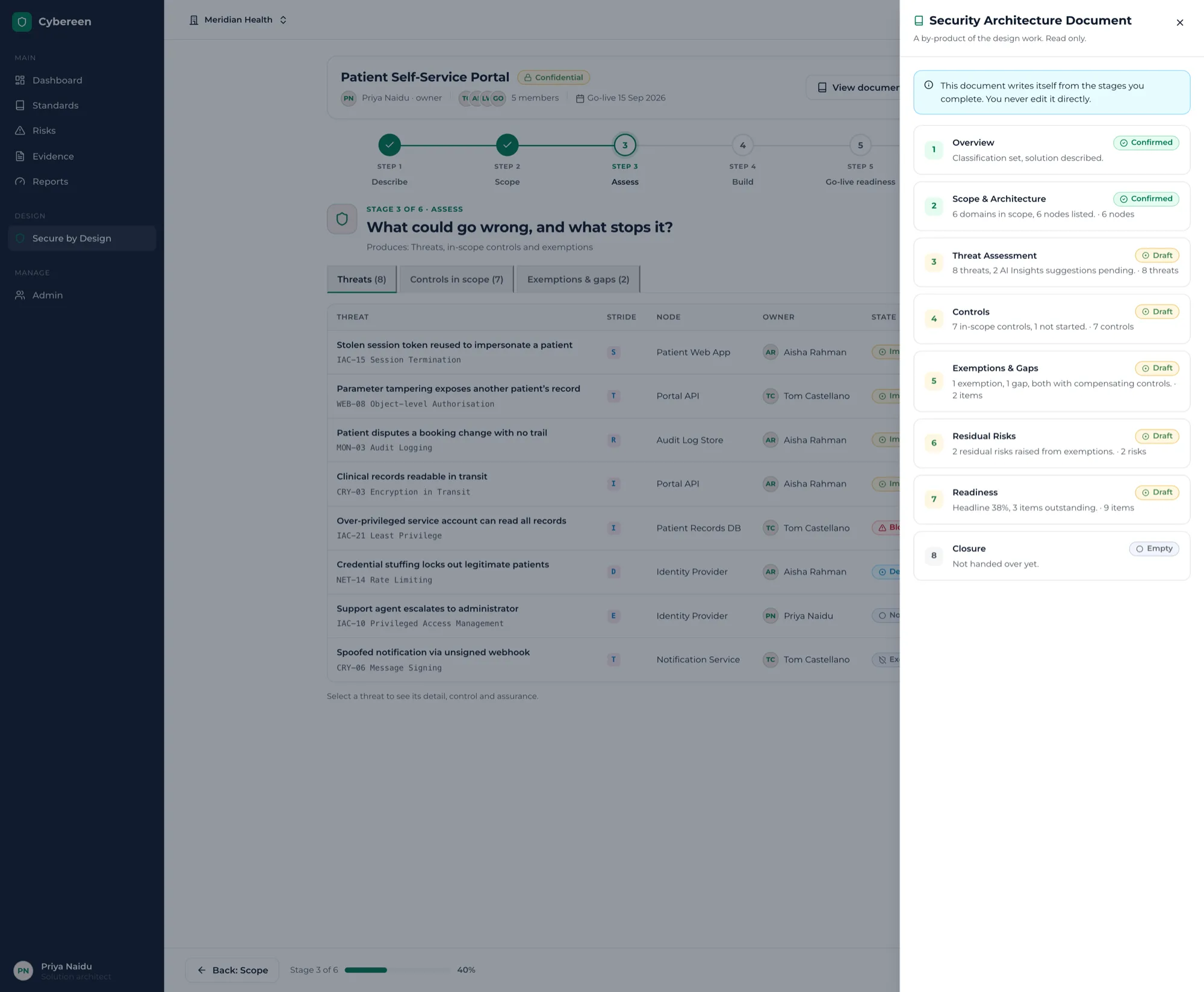
Each chapter is marked Confirmed, Draft or Empty, derived purely from whether the underlying work exists. If a number can't be re-derived from the records, it doesn't appear.
- Confirmed - the work behind the chapter is committed and complete.
- Draft - the chapter has content but isn't finished; you can see exactly what's outstanding.
- Empty - no work yet, honestly shown as a gap rather than a padded page.
- No invented figures, no back-dated write-ups - the document is only ever as complete as the work.
The document, assembling itself as you work.
Open it beside the journey at any stage. Each chapter shows its own state - Confirmed, Draft or Empty - derived from the records behind it. Illustrative project shown.
Six chapters, each from its own source.
The chapters mirror the journey. Each one is fed by a real surface in the platform, so it's evidence, not narrative.
What the solution is and how sensitive its data is, from the Describe stage.
The in-scope domains and the architecture nodes, from the Scope stage.
The threats per node and the controls that answer them, from Assess.
What was exempted, its compensating controls, and the risk formally accepted.
The pre go-live checklist and the derived readiness position.
The closure summary and who owns the solution now it's live.
Questions about the document.
Do I write the document, or does the platform?
Can I trust the figures in it?
Is it board- and auditor-ready?
Is this a separate tool?
Get a real design record, without writing one.
Work your next solution through the journey and the Security Architecture Document assembles itself. Book a walk-through and we'll show you on a real project.