Secure by Design, built into every project.
Make security decisions while the solution is being designed, not in a review the week before go-live. Cybereen gives your team a six-stage workflow from design document to signed-off security architecture.
Upload your design docs and the AI co-pilot derives the applicable controls, threats and scope. You review and commit; a living Security Architecture Document assembles as you go.
Request received.
Thanks - we'll be in touch within one business day to find a time for your walk-through. Check your inbox for a confirmation.
Maps to → Essential 8 ISO 27001 ISO 42001 APRA CPS 234 NIST CSF 2.0 the SCF control catalogue
What is Secure by Design?
Secure by Design is an approach where a system's security is decided while it is being designed, not checked after it is built. Threats are identified, controls chosen and exceptions agreed before anyone builds.
It's the approach ASD's Australian Cyber Security Centre promotes in its Secure-by-Design Foundations. Cybereen turns it into a workflow your project teams actually follow.
Security reviewed at the end
- Security sees the design after it's built
- Threats found late mean costly rework
- Controls chosen from scratch every project
- Exceptions get quietly skipped
- Architecture document written after the fact
Secure by Design in Cybereen
- Security shapes the design before build starts
- Threats identified against each component at design time
- Approved patterns bring their controls with them
- Every exception has an owner, a compensating control and an expiry
- The document builds itself from the work
The principles of Secure by Design
- Decide security at design time: before build starts, when a change costs a conversation rather than rework.
- Model threats per component: every part of the architecture gets its threats and a control that answers each one.
- Reuse approved patterns: proven building blocks such as SSO or central logging bring their controls with them.
- Make exceptions explicit: every skipped control has an owner, a reason, a compensating control and an expiry.
- Assure independently: the person who built a control isn't the one who signs it off.
- Keep one living record: the security architecture document is produced by the work, not written afterwards.
Cybereen already tracks compliance once a system exists. Secure by Design adds the design stage in front of it, and every decision writes straight through to your existing Applied Controls, Risks and Evidence. Nothing is re-keyed, and there's no second system to keep in sync.
How Secure by Design works: one project, six stages.
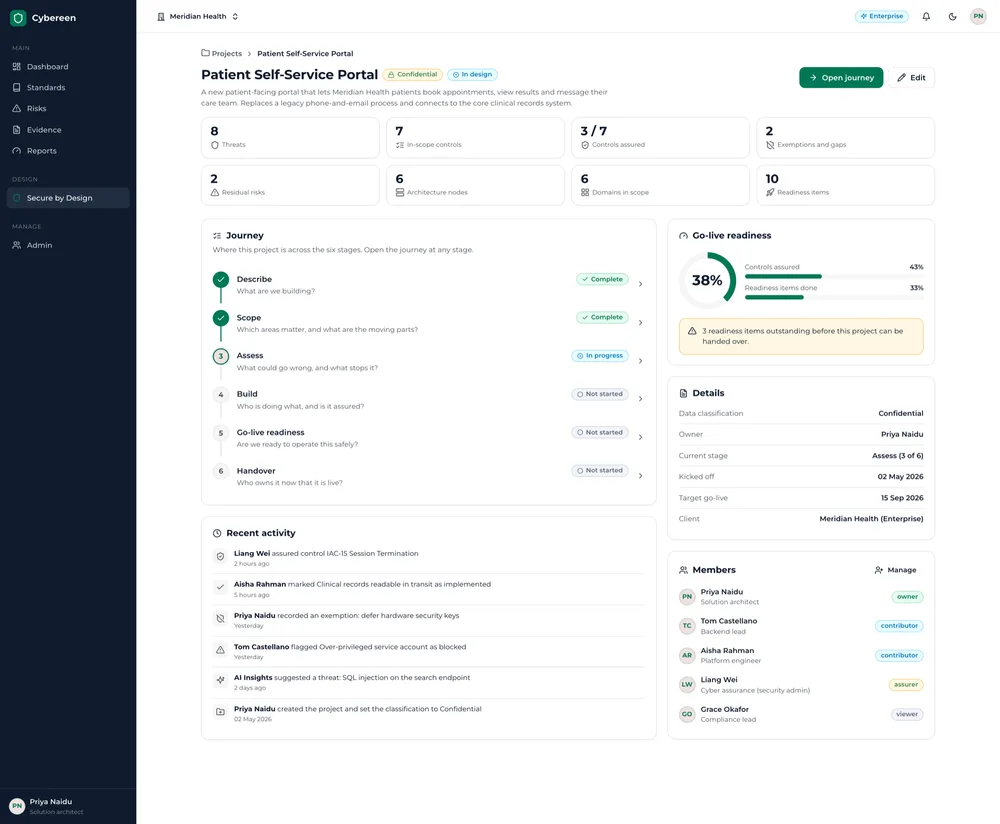
Follow an example project: a patient self-service portal that handles personal health data.
-
Describe the solution and its data
You: name the solution and answer a short intake.
Cybereen: suggests the data classification straight from your description.
Result: project overview & classification -
Scope components and security domains
You: upload solution-design.pdf.
Cybereen: identifies the components and the security domains in scope, drafted for you to edit.
Result: in-scope domains & architecture node map -
Assess threat modelling and controls
You: accept, edit or dismiss each suggestion.
Cybereen: drafts threats for each component and maps each one to the SCF control that mitigates it. Exemptions and project risks flow straight into Cybereen Risks.
Result: threat table with owner, state and due date How AI-assisted threat modelling works →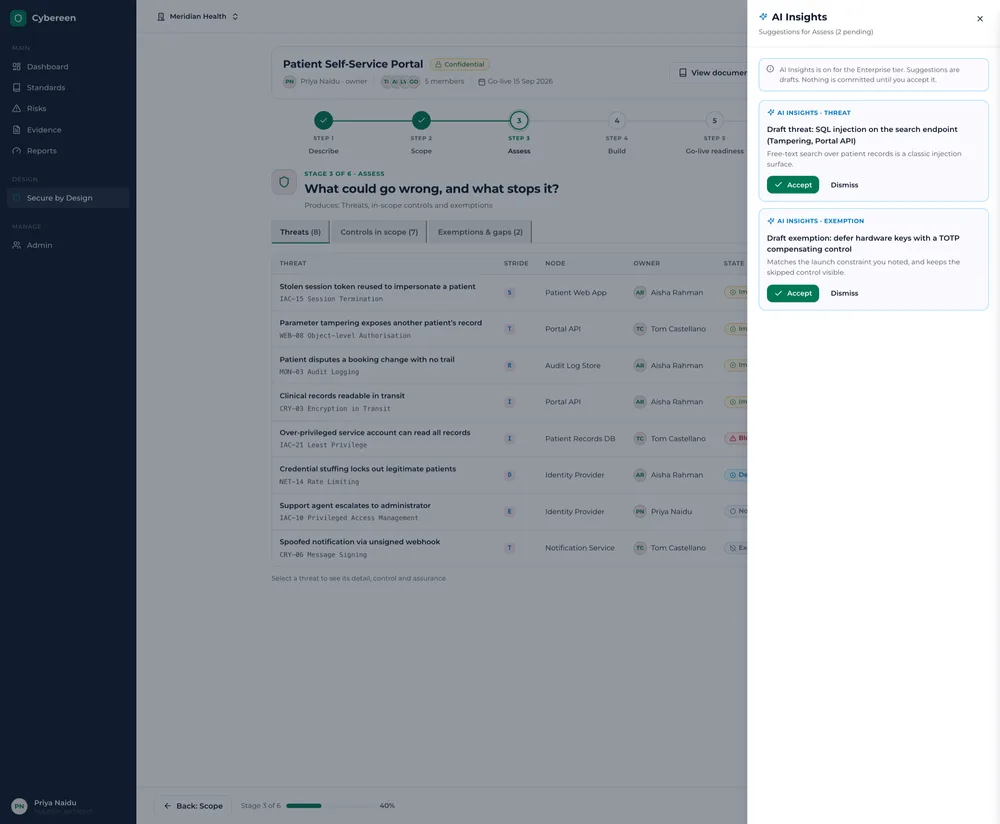
-
Build security patterns and implementation
You: apply approved patterns and track implementation by owner and date.
Cybereen: the SSO pattern brings its MFA, session and access-review controls, so you only assess what's different.
Result: control status per component, exceptions logged Browse reusable security patterns → -
Go-live readiness built versus assured
You: work through the readiness checklist.
Cybereen: works out readiness from the real status of each control, and one hard gate holds go-live until every item is cleared. Built is not the same as assured.
Result: go / no-go view, gaps visible -
Handover owners and residual risk
You: confirm the long-term owners and accept the residual risk.
Cybereen: writes the closure summary: scope, controls, exemptions and residual risk.
Result: named owners after launch
The Security Architecture Document writes itself.
You don't write it. Doing the work produces it.
- Every chapter shows its real state. Confirmed, Draft or Empty is derived from the underlying work, never typed in.
- Updates as the project changes. Scope, threats, controls, exemptions and residual risk assemble as you commit them.
- Ready for the board and auditors. One record of how the solution was designed to be secure.
| 1. Overview & classification | from Describe | Confirmed |
| 2. Scope & architecture nodes | from Scope | Confirmed |
| 3. Threats & controls | from Assess | Draft |
| 4. Exceptions & residual risk | from Build | Draft |
| 5. Go-live readiness | from Go-live | Empty |
| 6. Handover | from Handover | Empty |
Three Secure by Design rules the module enforces
AI drafts. People commit.
The co-pilot only writes suggestions. Nothing becomes a control, a risk or part of the design document until someone approves it.
Built isn't assured.
Implemented and independently verified are tracked separately, and no one can assure a control they built themselves.
No silent gaps.
Every exception has an owner, a reason, a compensating control and an expiry date. A skipped control is never invisible.
Secure by Design FAQ
What is Secure by Design?
What are the principles of Secure by Design?
What is an example of Secure by Design?
How does the AI derive controls from my documents?
Is this a separate platform to learn?
What does "built is not assured" mean in practice?
What do we get out of it at go-live?
Do we have to use the AI co-pilot?
Design your next solution secure from day one.
See it on one of your own projects in a 30-minute walk-through.